
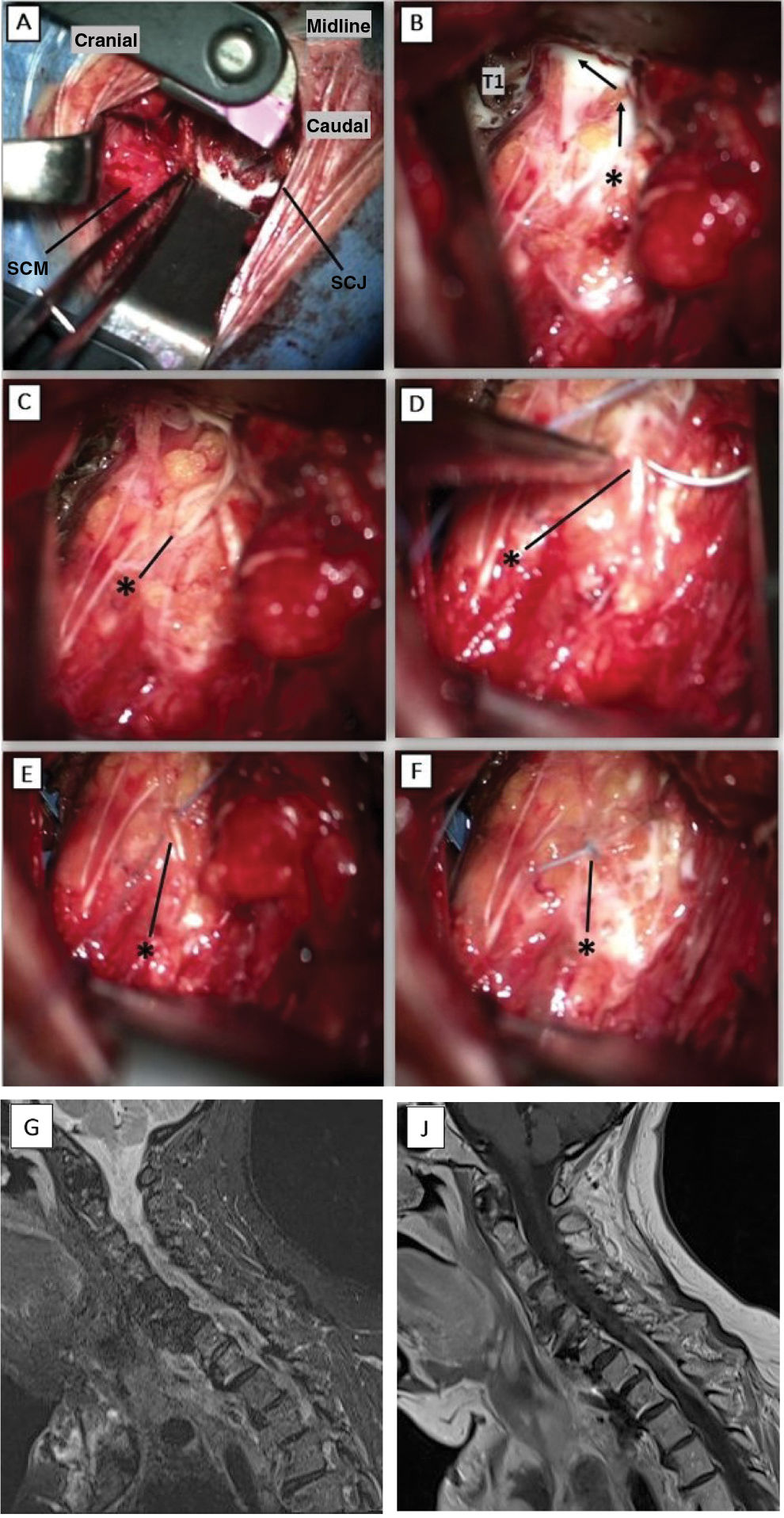
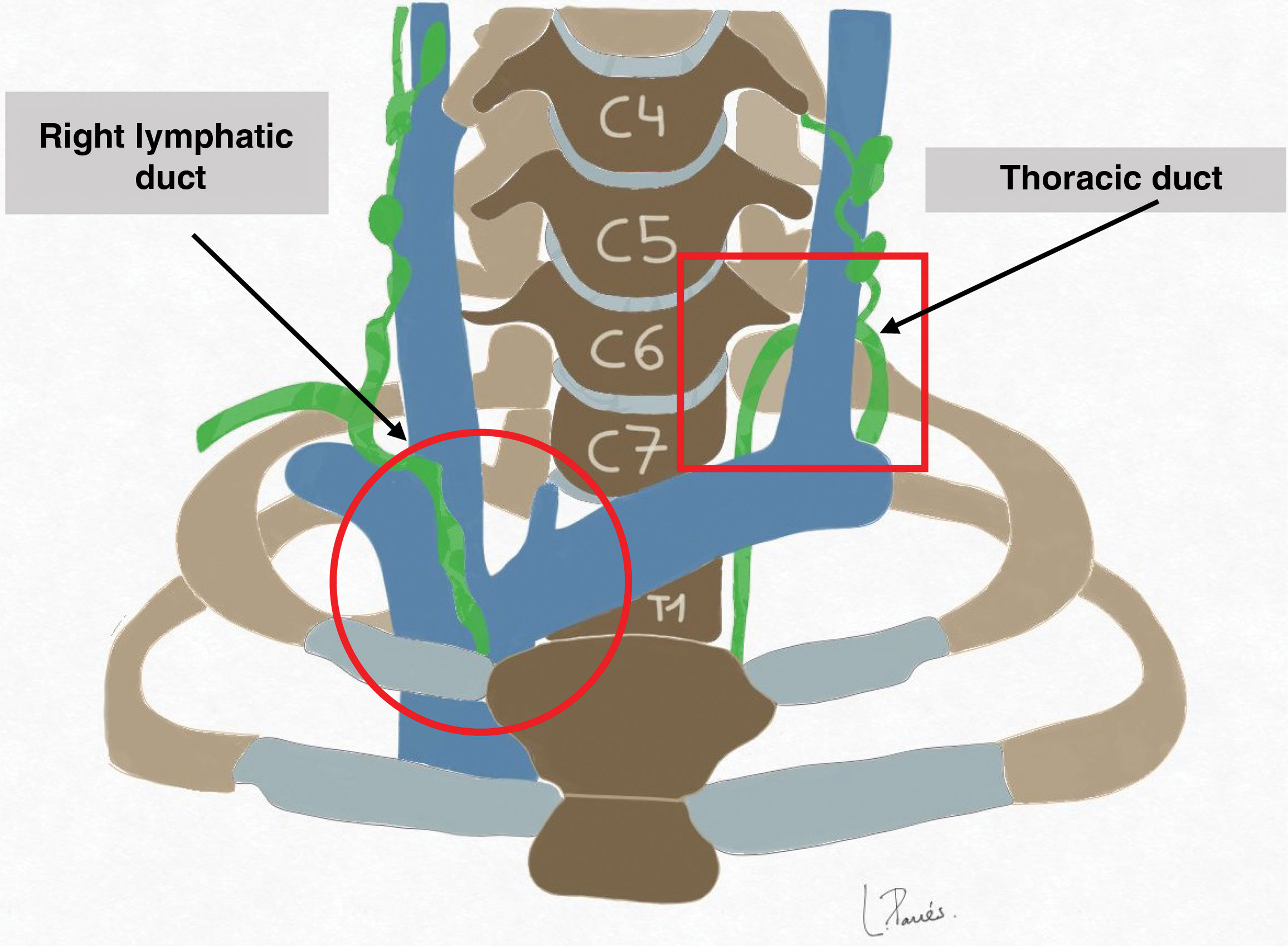
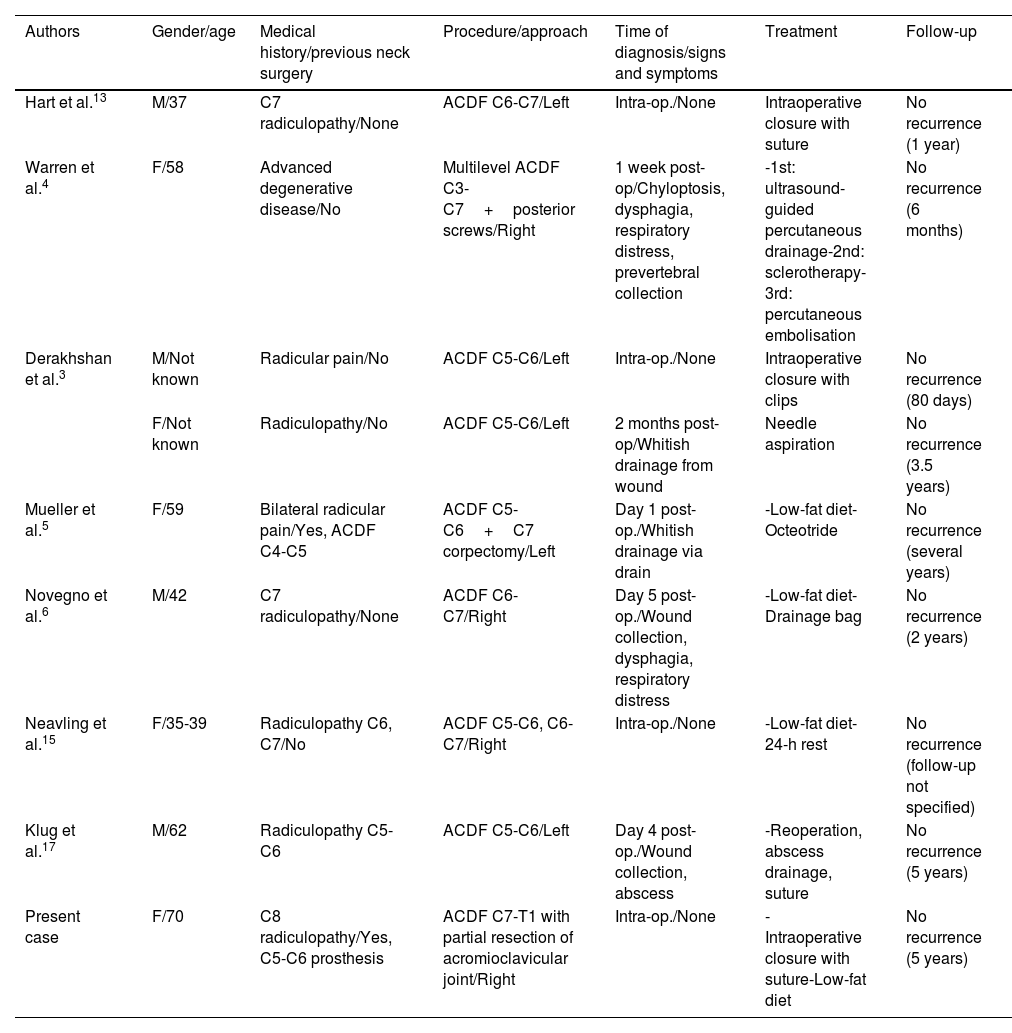
The anterior approach to the cervical spine is a widely used technique in spinal surgery. Although its most common complications involve vascular, neural, or digestive structures, there is also the potential for injury to lymphatic vessels, which can lead to serious complications if not promptly diagnosed and treated. We present the case of a 70-year-old woman with a history of lumbar arthrodesis and a C5-C6 cervical prosthesis, who underwent an anterior microdiscectomy at C7-T1 via a right-sided approach. During dissection, a dense whitish fluid compatible with chyle was observed, indicating injury to a lymphatic vessel. Ligation with suture was performed and a prevertebral drain was placed. In the postoperative period, the patient developed a mild hematoma in the acromioclavicular region, without cervical collections. The drain was removed after four days of total fasting, followed by the introduction of a low-fat diet. The patient was discharged without complications. After five years of follow-up, no associated complications have been observed. Chyle fistula following anterior cervical discectomy is a rare complication (0.02%) and should be suspected in the presence of milky fluid in the surgical wound, drainage, and/or progressive accumulation. Early diagnosis and appropriate treatment are essential to prevent more severe outcomes. The risk is higher in left-sided approaches near C6 and low right-sided approaches (C7-T1), particularly in the presence of anatomical variants.
El abordaje anterior a la columna cervical es una técnica ampliamente utilizada en cirugía de columna. Aunque sus complicaciones más frecuentes afectan a estructuras vasculares, nerviosas o digestivas, también existe la posibilidad de lesionar vasos del sistema linfático, pudiendo causar complicaciones graves si no se diagnostican y tratan de forma precoz. Presentamos el caso de una mujer de 70 años, con antecedentes de artrodesis lumbar y prótesis C5-C6, intervenida mediante microdiscectomía anterior C7-T1 por abordaje derecho. Durante la disección, se identificó la fuga de líquido blanquecino denso compatible con quilo, tras la lesión de un vaso linfático. Se realizó ligadura con sutura y se colocó un drenaje prevertebral. Durante el postoperatorio desarrolló un hematoma leve en la zona acromioclavicular, sin colecciones cervicales. El drenaje fue retirado tras 4 días de dieta absoluta, iniciándose dieta baja en grasas. La paciente fue dada de alta sin complicaciones. Tras 5 años de seguimiento no ha desarrollado ninguna complicación asociada. La fístula de quilo tras discectomía cervical anterior es una complicación infrecuente (0,02%), debe sospecharse ante la presencia de líquido lechoso en la herida o el drenaje y/o acúmulo progresivo. Su diagnóstico precoz y el tratamiento adecuado son claves para evitar complicaciones mayores. El riesgo es mayor en abordajes izquierdos cercanos a C6 y derechos bajos (C7-T1), especialmente en presencia de variantes anatómicas.
Article

If it is the first time you have accessed you can obtain your credentials by contacting Elsevier Spain in suscripciones@elsevier.com or by calling our Customer Service at902 88 87 40 if you are calling from Spain or at +34 932 418 800 (from 9 to 18h., GMT + 1) if you are calling outside of Spain.
If you already have your login data, please click here .
If you have forgotten your password you can you can recover it by clicking here and selecting the option ¿I have forgotten my password¿.