
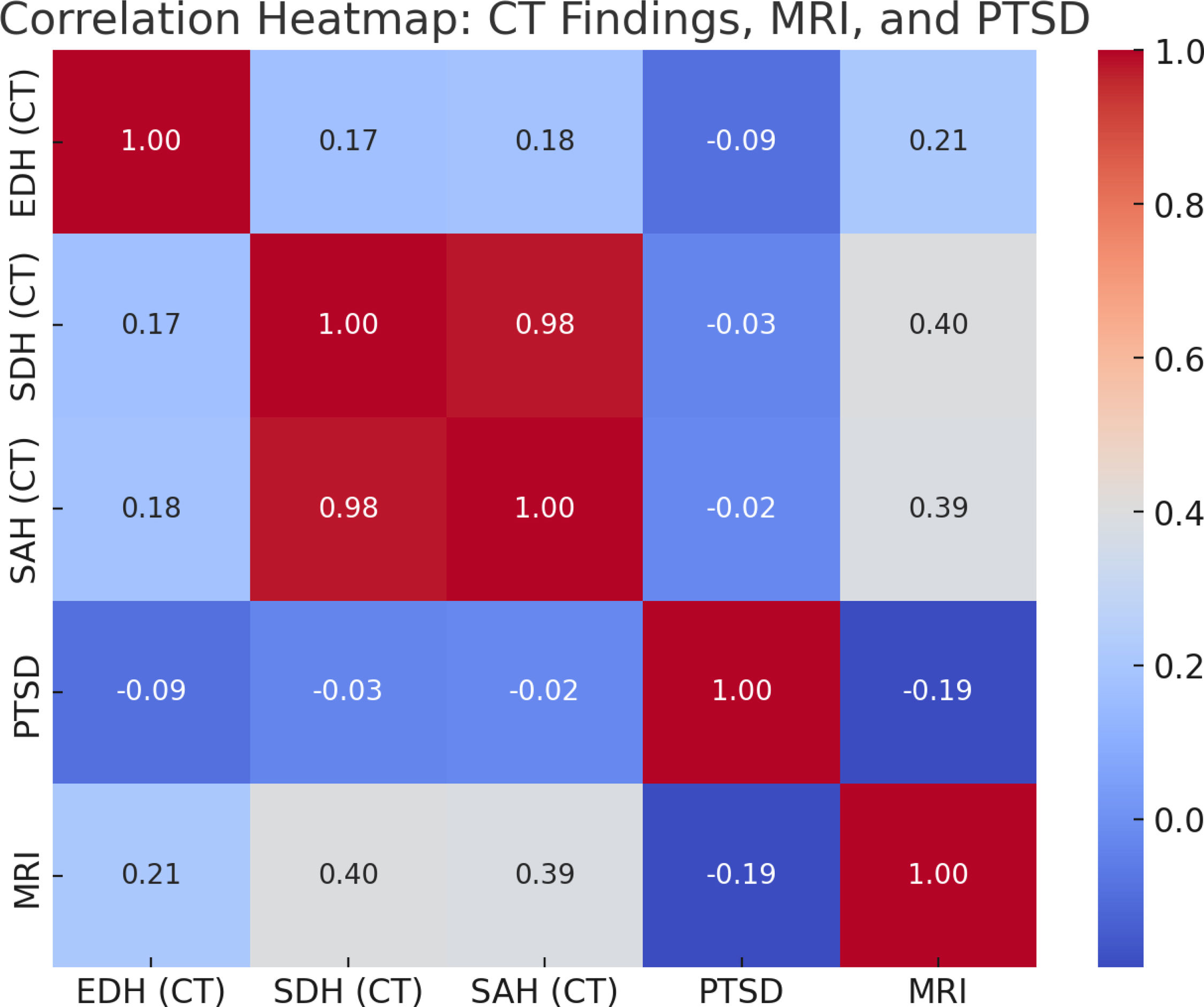
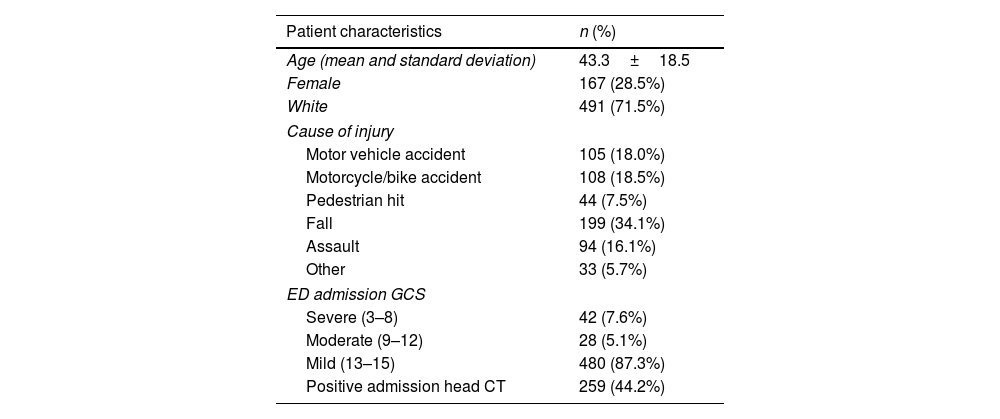

Traumatic brain injury (TBI) can lead to post-traumatic stress disorder (PTSD), with risk factors potentially linked to injury characteristics visible on imaging. This study examines associations between PTSD at 6 months and two imaging features: bleed location (epidural, subdural, subarachnoid, and contusions) and MRI pathology.
MethodsUsing data from the TRACK-TBI Pilot Dataset, we analyzed imaging characteristics and PTSD status in 586 patients. Bleed types and MRI results were assessed in relation to PTSD rates at 6 months. We applied logistic regression for bleed locations and chi-square testing for MRI findings to determine statistical significance.
ResultsBleed location did not significantly predict PTSD at 6 months. Logistic regression analysis showed no significant association between specific bleed types (epidural, subdural, subarachnoid, or contusions) and PTSD risk (p>0.05 for all bleed types). However, MRI findings showed a statistically significant association with PTSD status (p=0.048). Patients with positive MRI findings indicating pathology had a lower PTSD prevalence (20.9%) compared to those with negative MRI findings (36.7%) or uncertain findings, where no PTSD cases were observed.
ConclusionWhile bleed location is not significantly associated with PTSD risk, MRI results suggest a possible link between brain pathology and PTSD outcomes, with positive MRI findings associated with a lower prevalence of PTSD. These findings highlight the complex relationship between TBI imaging characteristics and PTSD risk, suggesting that MRI pathology may serve as a marker for differential PTSD outcomes. Future studies should explore underlying mechanisms and integrate clinical, genetic, and imaging data to refine PTSD risk assessment in TBI patients.
La lesión cerebral traumática (LCT) puede conducir a trastorno de estrés postraumático (TEPT), con factores de riesgo potencialmente vinculados a características de la lesión visibles en los estudios de imagen. Este estudio examina las asociaciones entre el TEPT a los 6 meses y 2 características de imagen: la localización de la hemorragia (epidural, subdural, subaracnoidea y contusiones) y la afección en la resonancia magnética (RM).
MétodosUtilizando datos del conjunto de datos TRACK-TBI Pilot, analizamos las características de imagen y el estado de TEPT en 586 pacientes. Se evaluaron los tipos de hemorragia y los resultados de RM en relación con las tasas de TEPT a los 6 meses. Aplicamos regresión logística para las localizaciones de la hemorragia y prueba de Chi-cuadrado para los hallazgos de RM a fin de determinar la significancia estadística.
ResultadosLa localización de la hemorragia no predijo de forma significativa el TEPT a los 6 meses. El análisis de regresión logística no mostró asociación significativa entre tipos específicos de hemorragia (epidural, subdural, subaracnoidea o contusiones) y el riesgo de TEPT (p>0,05 para todos los tipos). Sin embargo, los hallazgos en la RM mostraron una asociación estadísticamente significativa con el estado de TEPT (p=0,048). Los pacientes con hallazgos patológicos positivos en la RM presentaron una menor prevalencia de TEPT (20,9%) en comparación con aquellos con la RM negativa (36,7%) o con hallazgos inciertos, en los que no se observaron casos de TEPT.
ConclusiónSi bien la localización de la hemorragia no se asocia significativamente con el riesgo de TEPT, los resultados de la RM sugieren un posible vínculo entre la afección cerebral y los desenlaces de TEPT, con hallazgos positivos en la RM asociados a una menor prevalencia de TEPT. Estos hallazgos subrayan la compleja relación entre las características de imagen en LCT y el riesgo de TEPT, y sugieren que la afección en la RM puede servir como marcador de desenlaces diferenciales de TEPT. Futuros estudios deberían explorar los mecanismos subyacentes e integrar datos clínicos, genéticos y de imagen para refinar la evaluación del riesgo de TEPT en los pacientes con LCT.
Article

If it is the first time you have accessed you can obtain your credentials by contacting Elsevier Spain in suscripciones@elsevier.com or by calling our Customer Service at902 88 87 40 if you are calling from Spain or at +34 932 418 800 (from 9 to 18h., GMT + 1) if you are calling outside of Spain.
If you already have your login data, please click here .
If you have forgotten your password you can you can recover it by clicking here and selecting the option ¿I have forgotten my password¿.